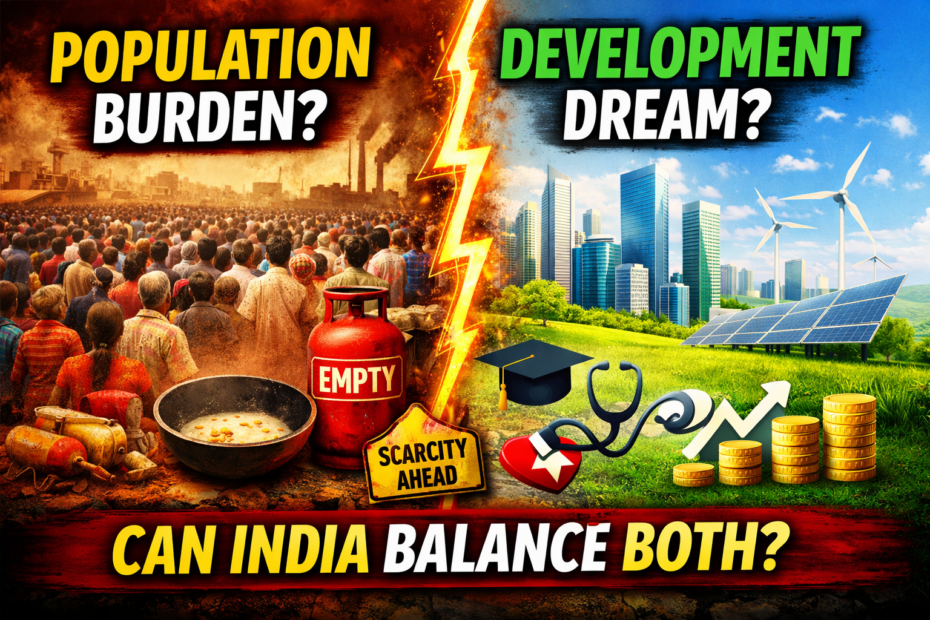
Population and development are two truths that can never go together.”
This was the belief of Thomas Robert Malthus.
According to him, if population growth is not controlled, a time will come when people will not have enough food and basic resources to survive. And when humans fail to control this imbalance, nature restores it in its own way — often through harsh and devastating means.
We all understand what those “ways” could be.
Lessons from History: Europe’s Transformation
There was a time when many European countries faced a situation similar to India today — high population and scarcity of food.
However, events like the World War I and World War II drastically reduced the male population. This forced women to step out of their homes and join the workforce.
This shift brought massive social and economic transformation:
- Increased participation of women in the economy
- Delay in marriages
- Decline in birth rates
- Structural changes in society
Should India Wait for a Crisis?
So, should India wait for a war or a natural disaster to control its population?
Absolutely not.
Such events not only reduce population but also destroy natural resources and human potential. Instead, we must take conscious steps to make growth sustainable and balanced.
What India Is Already Doing Right
It is important to acknowledge that India is not doing everything wrong. Several initiatives have been in place for decades:
✔️ Family Planning Programs
Since the 1950s, India has been running family planning initiatives:
- Free contraceptives
- Awareness campaigns
- Slogans like “Hum Do, Hamare Do”
✔️ Focus on Women’s Education
Education among women is improving, especially in urban areas:
- Women are marrying later
- Couples are choosing to have fewer children
✔️ Improved Healthcare
- Infant mortality rates have significantly declined
- Earlier, families had more children due to uncertainty of survival
- Now, better healthcare has reduced this need
✔️ Legal Reforms
- Minimum age of marriage has been increased
- This allows individuals to make more informed life decisions
Then Why Is the Situation Not Improving Enough?
Despite all these efforts, population growth continues to be a challenge.
🔴 Weak Political Will
One of the biggest reasons is the lack of strong policy enforcement. Governments often hesitate to aggressively promote population control due to fear of losing elections.
🔴 Poverty and Social Security Concerns
For families living below the poverty line:
- More children = more earning hands in the future
- Children are seen as a form of social and economic security
🔴 Social and Religious Beliefs
Certain beliefs continue to influence family size:
- Preference for male children
- Cultural importance of large families
- Hesitation in adopting family planning methods due to religious or cultural reasons
🔴 Myths About Medical Methods
There are widespread misconceptions about:
- Sterilization
- Contraceptives
Many people fear:
- Health complications
- Weakness or long-term side effects
These myths prevent adoption of effective population control measures.
The Way Forward
The result of these challenges is clear — despite multiple efforts, population continues to grow.
To address this effectively, India needs:
- Greater involvement of religious and community leaders
- Continuous focus on girls’ education
- Stronger awareness campaigns at the grassroots level
- Social acceptance of family planning measures
Real change will only come when these ideas are accepted not just at the policy level, but within families and communities.