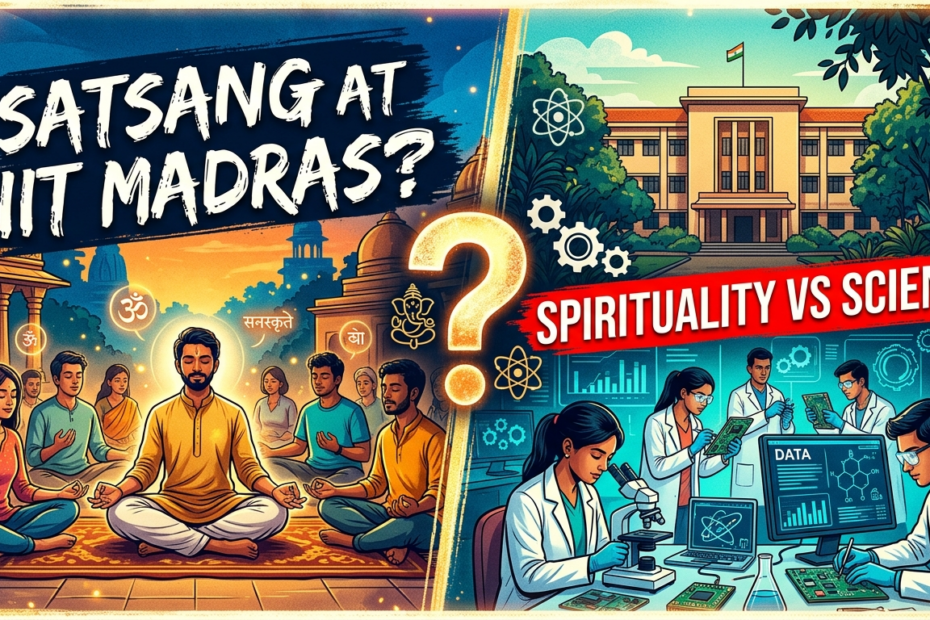
Is there any relationship between science and spirituality?
And more importantly—can science actually measure spirituality?
Before you decide, stay with this thought till the end… because this is not just a debate. It is a question that challenges the way we think.
For decades, the relationship between science and spirituality has remained a subject of intense debate. Science deals with evidence, measurement, and verification. Spirituality, on the other hand, is often seen as personal, subjective, and beyond quantification.
But recently, a significant development has brought this debate back into the spotlight.
On March 10, Indian Institute of Technology Madras established the Centre for Advanced Research on Spirituality, Science and Society. This move has sparked both curiosity and controversy.
What Will This Centre Actually Do?
According to official information, the centre aims to explore questions such as:
- What impact does meditation have on human health?
- How do spiritual experiences influence our psychology and cognition?
- What effect do architecture and spiritual spaces have on human behavior and emotions?
- Is there a connection between spirituality and medicine?
If you look closely, these are not just religious questions. They are deeply connected to human behavior, mental health, and society.
Where the Controversy Begins
This initiative has not been universally welcomed.
Some critics argue that science and spirituality operate in completely different domains. In their view, spirituality is inherently subjective—it cannot be reliably measured or scientifically verified. And if something cannot be tested or quantified, should it really fall within the scope of science?
There are also concerns about institutional priorities. Critics believe that premier institutes like IITs should focus strictly on hard sciences to maintain clarity and direction in research.
A more political dimension has also emerged. Some voices have labeled this move as an attempt at “saffronization” of education.
Another concern revolves around funding. The centre has been supported by spiritual leader Rajinder Singh. This has led to apprehensions that the research direction might gradually shift from scientific inquiry to religious discourse.
However, there are important facts that often get overlooked. Rajinder Singh is himself an alumnus of IIT Madras (1967 batch). Moreover, the centre is not an independent scientific department—it has been placed under the Humanities and Social Sciences division.
The Other Side of the Argument
Now let’s consider a different perspective.
India has long been regarded as the birthplace of spirituality and meditation. Across the world, there is growing interest in practices like mindfulness, yoga, and consciousness studies.
So the question arises—
If the world is trying to understand these concepts, why should India hesitate to study its own intellectual and spiritual heritage?
And this trend is not limited to India.
Institutions like Massachusetts Institute of Technology have been engaging with questions related to human consciousness, cognition, and the broader dimensions of human experience.
The logic is simple yet powerful:
If technology is advancing rapidly, understanding human consciousness becomes equally important. After all, powerful technology in the hands of an unwise mind can lead to unintended consequences.
A Bridge or a Blur?
So, is this centre a progressive step—an attempt to build a bridge between science and spirituality?
Or is it an experiment that risks blurring the boundaries of scientific rigor?
Perhaps the real question is not whether science and spirituality are separate.
The real question is:
- Are we ready to explore them together?
- Or do we still prefer to see them as two completely different worlds?
Because in the end, this is not just an academic discussion.
It is a question about how we understand ourselves, our society, and our intellectual heritage.
What Do You Think?
Can science and spirituality walk together?
Or should they remain apart?
The answer may not lie in choosing one over the other…
but in how open we are to asking the question itself.