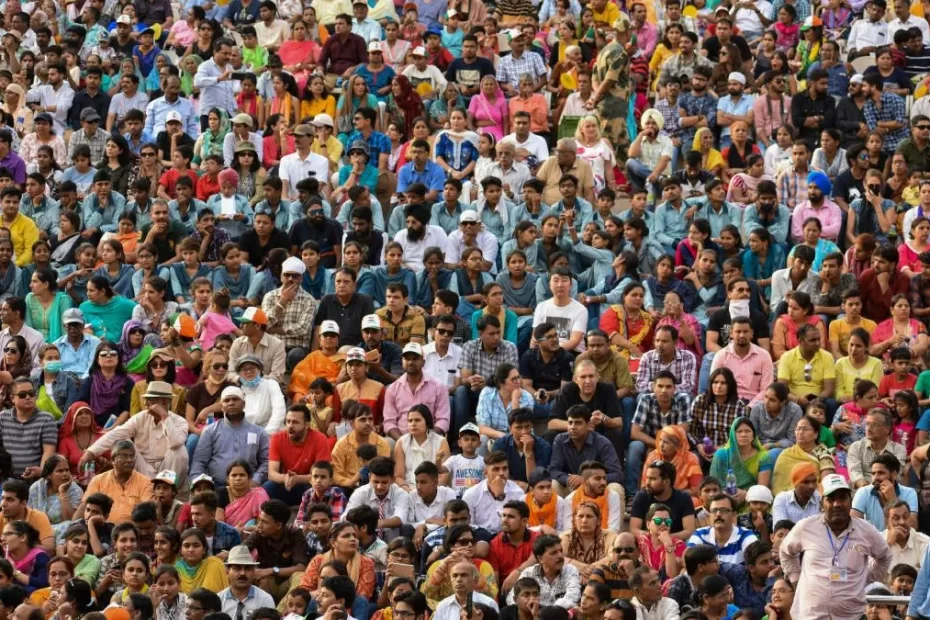
India today is struggling with many critical issues, but the root cause behind most of them is rarely discussed.
People are talking about shortages of gas cylinders and questioning why the government did not build adequate strategic reserves. But why is the opposition not asking a more fundamental question — what policies has the government implemented so far to control population growth?
Why is our desire to win elections slowly defeating the nation itself?
We all know that nearly 18% of the world’s population lives in India. But when it comes to natural resources, India has access to only about 4% of the world’s total resources. This imbalance is the core reason why much of our foreign policy revolves around securing natural resources. We are often unable to take strong stands on global issues because every action depends on resources we simply do not have in abundance.
Now, some may argue — how is China managing this situation?
Let’s understand China. Around 17% of the world’s population lives in China, and it possesses roughly 17% of global natural resources. This creates a far more sustainable balance. India, however, stands in a completely different position.
In January 2026, the United Nations released a report titled “Global Water Bankruptcy.” India was highlighted as one of the most alarming examples.
To understand this better: India is the largest user of groundwater in the world. Yet, out of approximately 700 districts, 256 have already reached “critical” or “overexploited” levels of groundwater depletion.
Today, we are importing natural resources from other countries — even food items. But do you really think that in the future, other nations will continue to supply us indefinitely? That is unlikely. We will have to prepare for our own future.
In many discussions, people say — what kind of progress can a country achieve where 800 million people still depend on free food distribution?
But think deeper. Even after distributing food to such a large population, India still ranks 105th out of 127 countries in the Global Hunger Index. This means that despite record production and distribution every year, a significant portion of our population still goes to bed hungry.
As a result, governments remain occupied with ensuring food supply and managing basic resources, leaving little room to focus on long-term development.
The blame is not just on governments — it is also on us. Because we, as citizens, often demand exactly what the government continues to provide.
Before concluding, let’s address another common question: “We pay taxes — where does that money go?”
Every year, the Government of India is able to allocate only about 23% of its budget toward future planning and development. The remaining majority is spent fulfilling immediate responsibilities — food, subsidies, and essential services.
Just imagine — only 23% is being invested in the future, largely because of the massive population pressure. Subsidies on food, fuel, electricity — all of these are politically sensitive. The moment they are removed, governments risk losing elections. And no one wants to lose, because only those in power can make decisions.
To stay in power, governments must continue doing what ensures electoral victory.
If possible, start a discussion on this issue — because if not today, then at least in the future, change might become possible.
Thank you.