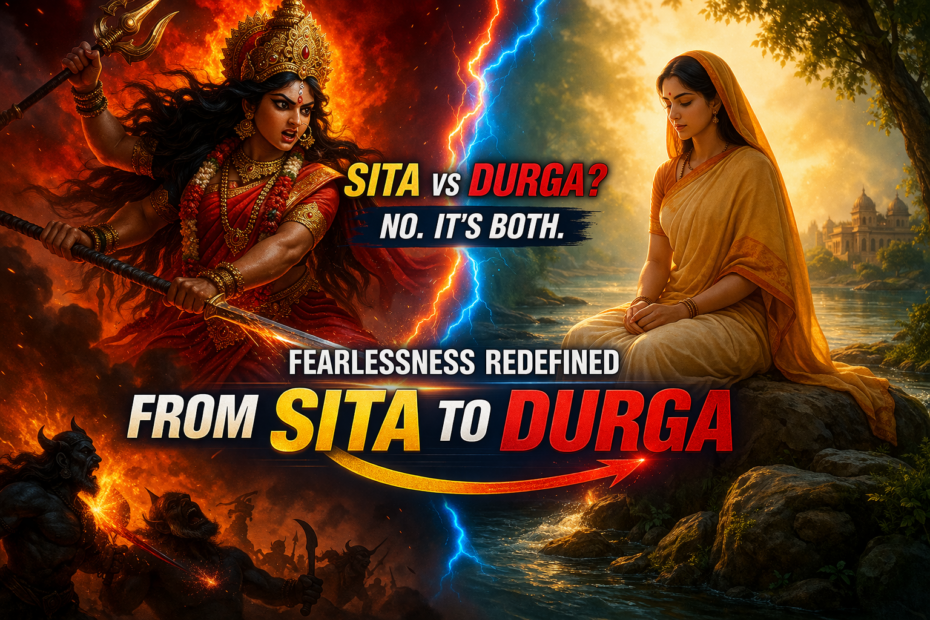
We often see people comparing their daughters and daughters-in-law to Maa Durga for their fearlessness. Hindu scriptures describe how Maa Durga established Dharma by defeating the Asuras, the forces of Adharma in society. Her image as a warrior makes her a powerful symbol of courage and action.
At the same time, we are also familiar with another great figure, Maa Sita, the wife of Lord Rama and the queen of Ayodhya. Yet, when discussions of fearlessness arise, Sita is rarely presented as a woman of courage who can face adversity. Instead, she is often limited to being seen only as a symbol of values and virtue. This raises an important question: Is Sita’s strength being misunderstood?
To explore this, it is helpful to look at the ideas of Swami Vivekananda, who offered a deeper understanding of these two powerful figures.
According to Vivekananda, Shakti—the divine feminine power—has two forms. Maa Durga represents the external form of Shakti, the strength required to fight evil and protect righteousness. She embodies the spirit of a warrior who rises in times of crisis. Thinkers have often used her image to inspire courage and determination, emphasizing the need for “muscles of iron and nerves of steel.” Durga is seen as the Mother of the Universe in her active and dynamic form—the energy that takes action to restore Dharma.
In contrast, Maa Sita represents the internal dimension of Shakti. While Durga is the power that acts, Sita is the power that endures. Vivekananda regarded her as the very soul of India. He believed that her greatness lies not in suffering, but in her extraordinary patience and unwavering commitment to truth. According to him, it is far more difficult to endure hardship with dignity than to defeat an enemy in battle.
Vivekananda went further to describe Sita as the national ideal. While there may be many forms of strength like Durga, Sita is unique. She represents purity, strength of character, and moral integrity—the very foundation of Indian spirituality. He even stated that if all the literature of the world were lost, but the story of Sita remained, the spirit of India would still survive.
At the same time, Vivekananda emphasized that the need of the hour was to awaken the spirit of Maa Durga. He believed that centuries of struggle had made society passive, and that people had mistakenly interpreted Sita’s patience as weakness. He urged society to combine both ideals—the purity and inner strength of Sita with the courage and action of Durga. In his vision, India needed hearts as pure as Sita’s and hands as strong and active as Durga’s.
Ultimately, Vivekananda brought these ideas together through the concept of motherhood. He observed that while the West often views womanhood through the role of a “wife,” Indian tradition sees it through the higher ideal of the “mother.”
In this framework, Maa Sita represents the nurturing mother who sustains life through love, sacrifice, and silent strength. She preserves the moral fabric of the family and society. On the other hand, Maa Durga represents the protective mother who defends her children with power and courage, standing firmly against any threat to their well-being.
The contrast between Maa Sita and Maa Durga is not a conflict, but a complement. Together, they present a complete vision of strength—one that combines inner resilience with outer courage. While Durga teaches us how to confront and overcome external challenges, Sita teaches us how to remain unshaken within.
In today’s world, true fearlessness lies in embracing both these dimensions. A society that understands only Durga may become aggressive, and one that sees only Sita may become passive. But a society that learns from both will achieve balance, strength, and harmony.
Perhaps it is time we redefine fearlessness—not just as the power to fight, but also as the strength to endure, to remain truthful, and to stand firm even in silence. Only then can we truly understand the complete meaning of Shakti.